There are many flail mowers available on the market, differing in design, weight, power requirements, equipment, and intended applications.
Marketing materials often feature simple claims such as “a heavier machine is better” or “a specific roller design ensures lower fuel consumption.”
However, without comparisons carried out under the same conditions, it is difficult to treat such claims as a reliable basis for a purchasing decision.
That is why, when choosing a mulcher, it is worth focusing primarily on parameters that can be measured and verified.
For example, according to the manufacturer’s specifications, the TALEX ECO 180 requires a minimum of 40 HP, while the ECO 220 requires 60 HP.
The LEOPARD DUO 200 requires a minimum of 40 HP, the DUO 250 requires 50 HP, and the DUO 280 requires 75 HP.
With such a wide range of models available, operators can choose a machine that matches their existing tractor rather than investing in an oversized tractor-and-mulcher combination.

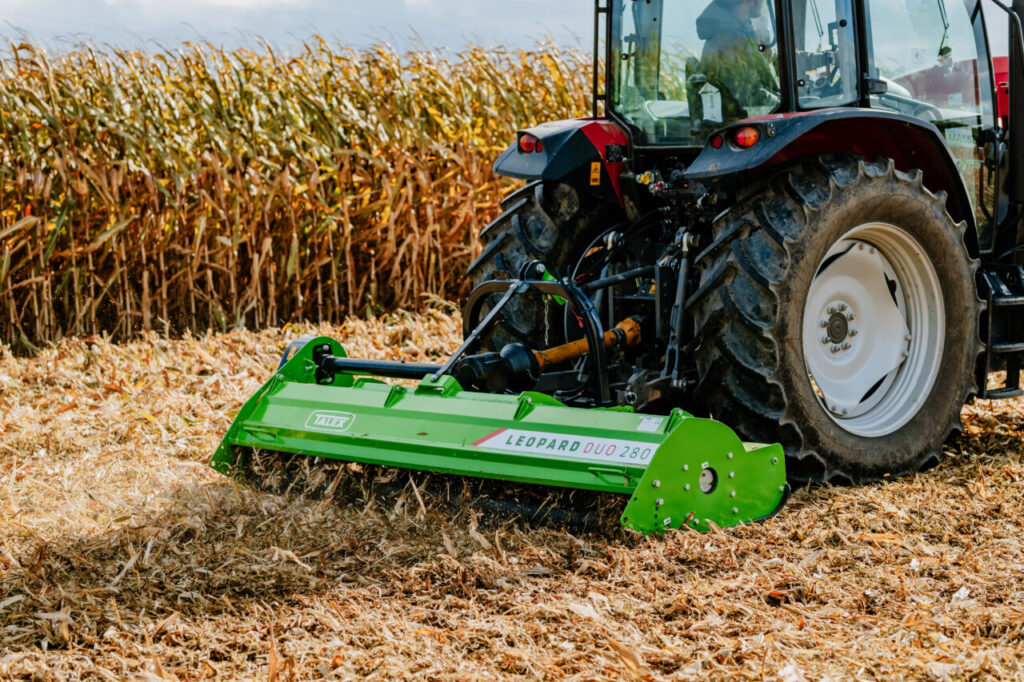
Working width alone does not tell the whole story.
According to TALEX catalogue data:
For a farm covering 500 hectares per season, the difference between a productivity rate of 1.3 ha/h and 2.24 ha/h is substantial.
At 1.3 ha/h:
500 ÷ 1.3 = approximately 385 hours
At 2.24 ha/h:
500 ÷ 2.24 = approximately 223 hours
The theoretical difference is approximately 162 hours of work saved in a single season.
Actual productivity naturally depends on terrain conditions, the type of material being mulched, the tractor used, and the operator’s experience. Nevertheless, this calculation clearly illustrates the significant economic impact that choosing the right working width and machine capacity can have.
Not necessarily.
The market offers mulchers with similar working widths but significantly different weights.
A heavier construction can be an advantage when tackling demanding mulching jobs and processing tough material. At the same time, greater weight places higher demands on the tractor, its lifting capacity, and the entire three-point linkage system.
A lighter design, on the other hand, may allow the machine to be used with a lower-powered tractor.
A good example is the TALEX ECO 180.
This machine has a working width of 1.80 m and a minimum power requirement of 40 HP.
Other machines on the market with the same or a similar working width may have higher minimum tractor power requirements.
This does not automatically mean that one design is better than another. It does, however, show why buyers should consider not just the mulcher itself, but the entire setup:
tractor + machine + type of work.
If one machine can be operated with a tractor the user already owns, while another requires a more powerful tractor, the economic difference can be far greater than a comparison of the machines alone would suggest.
No.
The purchase price alone does not tell you the actual cost of mulching one hectare.
Similarly, weight, the number of working elements, and power requirements should not be assessed in isolation.
A much more reliable approach is to calculate:
Fuel costs + operator labour + tractor costs + wear parts + servicing and maintenance.
Only this calculation provides a realistic picture of the machine’s actual operating costs.
Let’s assume the following:
Time required:
300 ÷ 1.6 = 187.5 hours
For this example, let’s assume:
Total hourly operating cost:
60 + 35 + 15 = PLN 110/h
Cost of completing 300 ha:
187.5 × 110 = PLN 20 625
Cost per hectare:
20,625 ÷ 300 = PLN 68.75/ha
Now, suppose actual productivity drops to 1.0 ha/h under more demanding working conditions.
This means a cost of:
PLN 110/ha
The difference is more than PLN 41 per hectare.
Across 300 ha, that amounts to over PLN 12000 in a single season.
This illustrates why, when choosing a flail mower, it is worth looking beyond its purchase price or weight and focusing primarily on the productivity of the entire tractor-and-machine combination under the specific conditions in which it will operate.


